

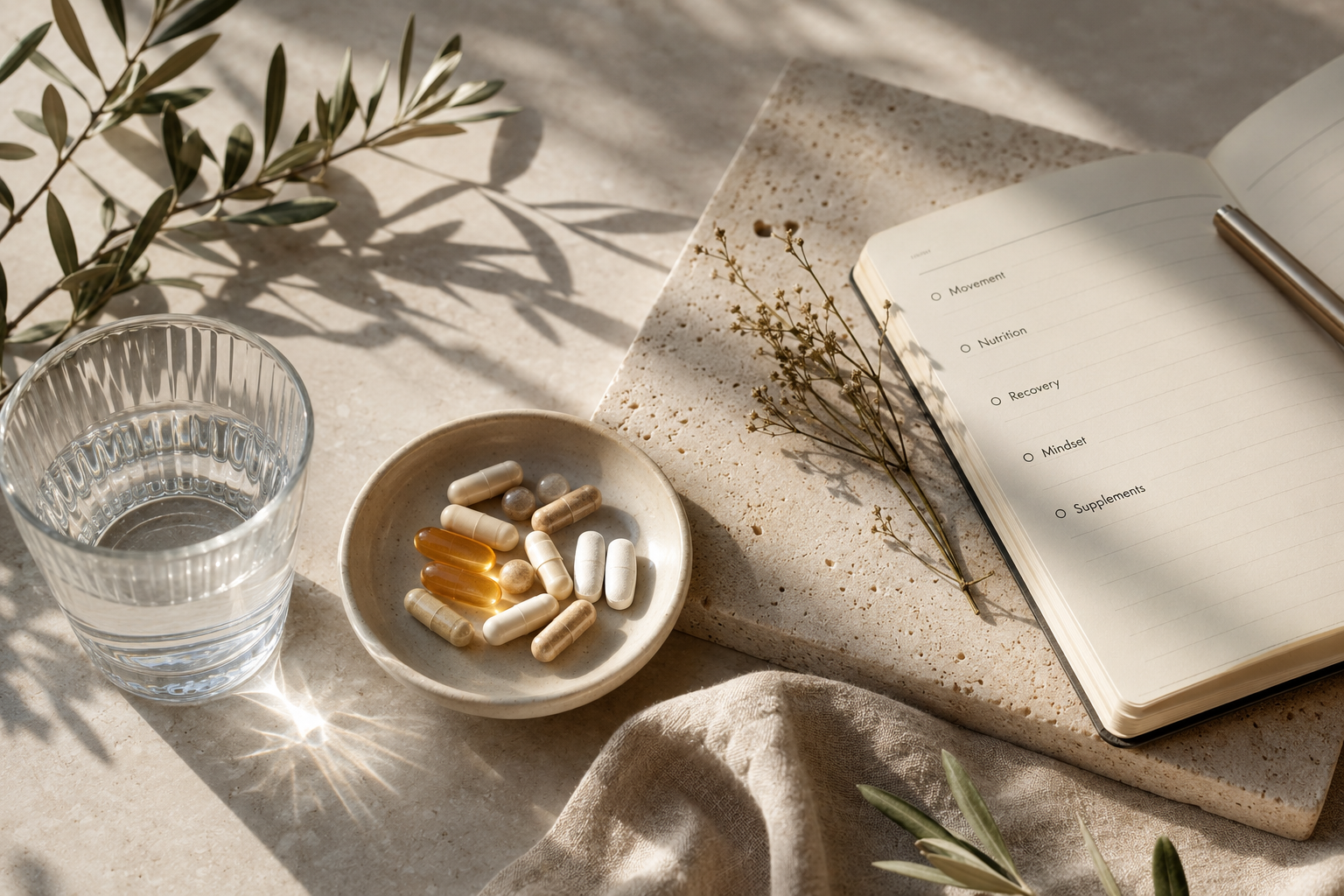
The best supplement routine for healthy ageing in your 30s, 40s and 50s
The way we age is shaped by many biological processes happening at the same time: how our cells produce energy, how well the body manages oxidative stress, how efficiently we repair and recover, how stable our metabolism is, how our muscles maintain strength, and how our sleep and nervous system support the body overnight.
This is why a serious longevity routine should not be built around random supplements. It should be built around what your body needs at your current stage of life.
Your 30s, 40s and 50s are not the same decade biologically. The goal is not to wait until ageing becomes visible. The goal is to support the systems that help the body stay resilient before decline becomes harder to reverse.
At L Cell, we approach longevity through science, quality and consistency. The right routine should be simple enough to follow daily, but intelligent enough to match the biological changes happening with age.
Why your supplement routine should change with age
In your 20s and early 30s, the body often feels like it can recover from anything: poor sleep, stress, intense work, irregular meals, alcohol, travel, and inconsistent routines.
But with age, the body becomes less forgiving. Energy production can feel less stable. Recovery may take longer. Sleep quality can change. Muscle becomes harder to maintain. Blood sugar fluctuations may become more noticeable. Skin, joints and connective tissue may need more support. The body’s natural repair systems still work, but they may require more consistency from your lifestyle.
In your 30s: build the foundation
Your 30s are the decade to build the base.
This is not the time to think that longevity is something for later. Many of the habits that shape how you age in your 40s and 50s are built now: sleep, movement, protein intake, stress regulation, blood sugar balance and daily recovery.
A strong supplement routine in your 30s should focus on energy, stress resilience, sleep quality, magnesium status, and metabolic stability.
For many people, this is the stage where tiredness becomes more noticeable. It may not feel dramatic, but energy is often less effortless than before. Work stress, poor sleep, inconsistent eating and too much screen time can all affect how the body feels day to day. This is where foundational ingredients matter.
Magnesium is one of the most important minerals to understand because it is involved in hundreds of biological reactions, including normal muscle function, nervous system function and energy metabolism. For people who feel physically tense, mentally overstimulated or unable to properly relax, magnesium is often one of the first ingredients to consider.
L Cell Magnesium Bisglycinate can fit well into an evening routine, especially for people who want a calm, consistent mineral supplement. L Cell Magnesium L-Threonate is more often chosen by people interested in brain-focused magnesium and cognitive longevity.
L-Theanine and Apigenin may also fit into a 30s routine for people who want to support a calmer evening ritual. They should not be treated as sleeping pills, but as part of a structured nighttime routine that supports the transition from stress to rest.
This is also a good decade to start thinking about metabolic health. Stable meals, enough protein, regular movement and blood sugar awareness matter more than most people realise. L Cell Berberine can be relevant for people interested in metabolic wellness and a more intentional approach to appetite, cravings and post-meal balance.
A simple 30s routine could include magnesium, L-Theanine or Apigenin in the evening, and Berberine for those focused on metabolic health. The goal in your 30s is not to overcomplicate - it is to build a foundation that makes ageing easier later.
In your 40s: focus on metabolism, mitochondria and recovery
Your 40s are often the decade where people begin to notice that the body is changing. Energy may become less predictable. Recovery after exercise, travel or stress may take longer. Muscle becomes more important. Blood sugar balance, sleep and inflammation-related lifestyle factors can start to matter more. This is also the decade when many people begin to understand that ageing is not only visible on the skin - it is happening at the cellular level.
A supplement routine in your 40s should focus on mitochondrial health, NAD+ pathways, metabolic wellness, muscle maintenance and recovery. NAD+ is one of the most important molecules in longevity science because it is involved in cellular energy metabolism and repair-related processes. NAD+ levels are widely discussed in ageing research because they are connected to how cells produce and use energy.
This is where L Cell NAD+ Formula, NR, NMN and TMG become relevant.
NR and NMN are both NAD+ precursors, meaning they are studied for their role in NAD+ biology. TMG is often discussed alongside NAD+ routines because methylation becomes an important topic when people take NAD+ precursors consistently. For people in their 40s, an NAD+ routine can be one of the most logical steps in a longevity stack. It fits the decade where energy, recovery and cellular maintenance become more important.
Mitochondria also deserve attention in this decade. They are the parts of the cell responsible for producing energy, but they are also deeply connected to ageing biology. L Cell Urolithin A is especially relevant here because it is studied in relation to mitophagy - the process connected to the renewal of mitochondria.
Creatine is another strong ingredient for this decade. It is often associated with athletes, but it is also increasingly discussed in the context of muscle, strength, energy and healthy ageing. Maintaining muscle is one of the most important practical longevity strategies, especially from midlife onward. For women, this becomes even more important as hormonal changes can affect body composition, recovery and muscle maintenance.
A strong 40s routine could include NAD+ Formula or NR/NMN with TMG, Urolithin A, Creatine, Magnesium, and Berberine if metabolic health is a focus. The goal in your 40s is to stop thinking only about “feeling better today” and start thinking about the systems that help the body stay strong for the next decade.
In your 50s: support repair, muscle, antioxidants and cellular clean-up
Your 50s are the decade where consistency becomes non-negotiable. This is when the body often needs more deliberate support for muscle, recovery, connective tissue, antioxidant systems, cellular clean-up and long-term resilience. It is not about doing extreme things. It is about having a routine that is stable, intelligent and realistic.
A supplement routine in your 50s should focus on muscle preservation, mitochondrial quality, cellular senescence research, glutathione-related antioxidant pathways, collagen support and sleep recovery.
Creatine becomes especially relevant in this decade because muscle is one of the strongest predictors of healthy ageing. Maintaining muscle supports strength, mobility, metabolism and independence over time. It is not only about fitness. It is about function.
Collagen Peptides can also fit into this stage, especially for people interested in skin, joints and connective tissue as part of a broader healthy ageing routine.
GlyNAC is another ingredient that belongs in a more advanced longevity conversation. It combines glycine and N-acetylcysteine, two compounds studied in relation to glutathione, one of the body’s major internal antioxidant systems. Oxidative stress is one of the central themes in ageing research, which makes antioxidant pathways especially relevant in midlife and beyond.
This is also the decade where cellular senescence becomes an important topic. Senescent cells are often described as cells that no longer function normally but remain active in the body. In longevity research, they are studied because they can influence tissue environment and inflammation-related signalling.
Ingredients such as Fisetin, Quercetin, Resveratrol and EGCG are often discussed in relation to senescence, polyphenol biology and cellular stress-response research. This does not mean they should be presented as a treatment or a guaranteed anti-ageing solution. But they are important ingredients to understand for anyone building a serious longevity routine.
Spermidine may also be relevant in this decade because it is studied in relation to autophagy, the body’s cellular recycling process. Autophagy is one of the key mechanisms discussed in ageing science because it relates to how the body clears and renews cellular components over time.
A strong 50s routine could include NAD+ support, Urolithin A, Creatine, GlyNAC, Collagen Peptides, Spermidine, Magnesium, and a senolytic-focused formula or polyphenol stack. The goal in your 50s is not to chase youth. The goal is to support strength, recovery and cellular maintenance with more precision.
The routine should match the person, not just the age
Age is useful, but it is not the full story. A 35-year-old with poor sleep, high stress and unstable meals may need a more recovery-focused routine than a healthy 48-year-old who exercises, sleeps well and eats consistently. A 52-year-old who strength trains may need different support than someone who is just beginning to rebuild their health.
This is why L Cell routines should be personalised around the main goal. If the goal is energy, the focus may be NAD+ support, Urolithin A, Creatine and Magnesium.
If the goal is metabolic wellness, the focus may be Berberine, GLP Formula, Magnesium and a protein-rich diet.
If the goal is sleep and recovery, the focus may be Magnesium Bisglycinate, L-Theanine and Apigenin.
If the goal is cellular ageing, the focus may be NAD+ support, Resveratrol, Quercetin, Fisetin, Spermidine, GlyNAC and Urolithin A.
If the goal is skin, joints and connective tissue, Collagen Peptides can become part of the routine alongside protein, hydration and strength training.
The best routine is not the one with the most products. It is the one that makes biological sense and can be followed consistently.
How to build your first longevity stack
If you are new to longevity supplements, start simple. A strong foundational routine can begin with three areas: energy, recovery and metabolic health.
For energy, consider NAD+ support, NR, NMN, Urolithin A or Creatine, depending on your goal.
For recovery, consider Magnesium, L-Theanine or Apigenin as part of a consistent evening routine.
For metabolic wellness, consider Berberine or GLP Formula, especially if your goal is a more structured approach to appetite, cravings and post-meal balance.
From there, the routine can become more advanced. Ingredients such as Spermidine, Fisetin, Quercetin, Resveratrol, EGCG and GlyNAC can be added when the focus becomes more cellular: autophagy, senescence research, oxidative stress and long-term maintenance.
This is the difference between taking supplements randomly and building a longevity system.
Scientific sources
López-Otín C et al. (2023). Hallmarks of aging: An expanding universe. Cell.
Kaufman MW et al. (2024). Nutritional Supplements for Healthy Aging: A Critical Analysis of Current Evidence. Nutrients.
Martens CR et al. (2018). Chronic nicotinamide riboside supplementation is well-tolerated and elevates NAD+ in healthy middle-aged and older adults. Nature Communications.
Andreux PA et al. (2019). The mitophagy activator urolithin A is safe and induces a molecular signature of improved mitochondrial and cellular health in humans. Nature Metabolism.
Bischof E et al. (2021). Health and Longevity: Practical Implications of the Hallmarks of Aging. Aging.
Bagheri R et al. (2021). Effects of creatine supplementation on muscle strength, body composition and physical function in older adults: a systematic review and meta-analysis. Journal of Cachexia, Sarcopenia and Muscle.
Sekhar RV et al. (2021). GlyNAC supplementation improves glutathione deficiency, oxidative stress, mitochondrial dysfunction, inflammation, insulin resistance, endothelial dysfunction, genotoxicity, muscle strength and cognition in older humans. Clinical and Translational Medicine.
Madeo F et al. (2018). Spermidine in health and disease. Science.
Kirkland JL, Tchkonia T. (2020). Senolytic drugs: from discovery to translation. Journal of Internal Medicine.


Hinterlasse einen Kommentar
Diese Website ist durch hCaptcha geschützt und es gelten die allgemeinen Geschäftsbedingungen und Datenschutzbestimmungen von hCaptcha.